
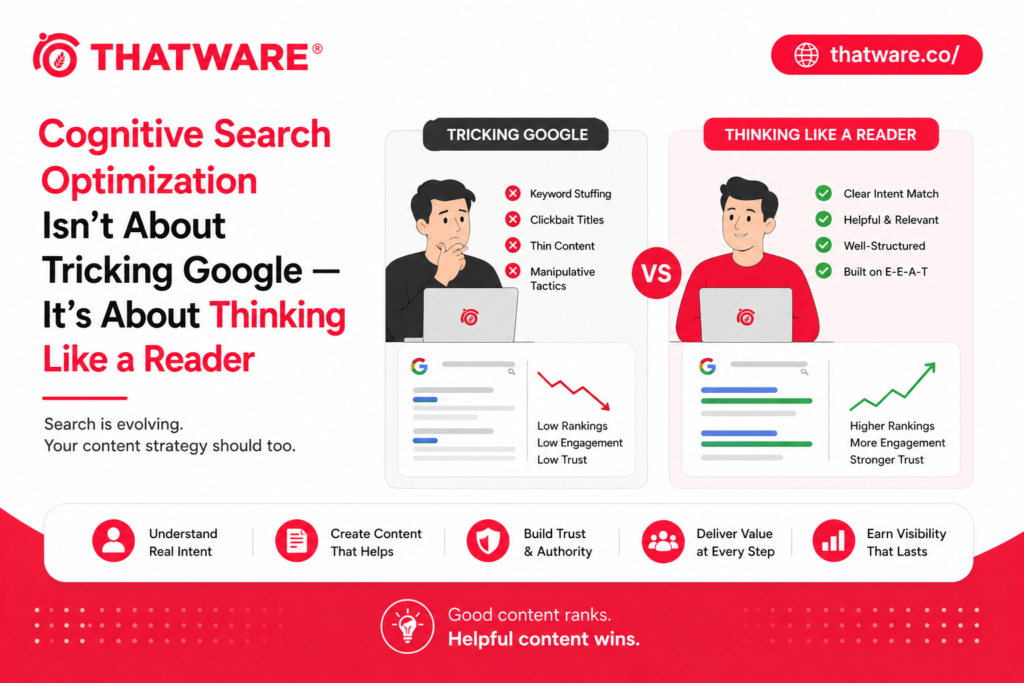
There’s a version of SEO that treats readers as a means to an end. You need humans to visit your pages so the behavioral signals look good to Google. You need them to stay long enough to count as engagement. You need them to click things that demonstrate intent. In this model, the reader is essentially an unwitting participant in your relationship with an algorithm.
Cognitive search optimization starts from the opposite assumption: that if you genuinely understand how readers think, what they’re trying to accomplish, and how their minds process information, you’ll build content that actually serves them — and as a direct result, you’ll send exactly the signals Google is trying to measure. Not because you’re gaming the metrics, but because the metrics are proxies for the thing you’re actually delivering.
This sounds like it should be obvious. In practice, it’s a meaningfully different way of approaching content strategy.
What Cognitive Processing Actually Means for Content
When someone arrives at a piece of content from a search result, they’re not reading linearly from start to finish. They’re scanning — running a quick visual triage to determine if this page is worth their attention. They’re pattern-matching — looking for signals that this page understands their specific question. They’re building a mental model — assembling an understanding of the topic from the pieces that register as relevant.
This is how human cognition actually works with information. And content that’s built with this in mind — that addresses the scanning behavior, that signals specificity early, that structures information to build mental models progressively — is experienced differently from content that dumps information in the order it was easiest to write.
The SEO implications of this cognitive reality are concrete. Content that quickly signals “yes, this is exactly what you were looking for” reduces the bounce rates that indicate to Google that a searcher found what they needed. Content that builds understanding progressively — from a clear direct answer, to explanation, to context, to nuance — matches the way readers actually consume information and keeps them engaged through depth, not tricks. Content that anticipates and answers the follow-up questions already forming in a reader’s mind creates the dwell time and multiple-page visits that signal genuine value.
The Cognitive Load Problem Most Content Ignores
Cognitive load — the mental effort required to process information — is one of the most consistently underappreciated factors in content performance. High-cognitive-load content drives readers away not because they’re lazy, but because processing dense, poorly organized, or confusingly structured information takes actual mental energy that people are rationally reluctant to spend when alternatives exist.
High cognitive load in content manifests in familiar ways: walls of text without visual organization, jargon without explanation, excessive qualifications before the main point, information presented in the order it was learned rather than the order it’s needed, and structure that requires the reader to hold multiple pieces of incomplete information in working memory before they can make sense of the whole.
Cognitive search optimization addresses this by designing content around how readers actually process it. Breaking information into digestible chunks. Leading with the most important information. Using headers that communicate content, not just categorize it. Building progressive complexity — starting simple and adding nuance, rather than front-loading complexity.
These aren’t just readability improvements. They’re cognitive experience improvements. And readers who have a genuinely good cognitive experience with your content — who leave feeling like they understood something, rather than feeling like they worked hard to extract minimal value — are the ones who come back, share, and become the kind of engaged audience that sends durable positive signals.
Intent Mapping at the Cognitive Level
Standard SEO keyword research identifies what people search for. Cognitive intent mapping asks a more interesting question: what is the reader trying to accomplish, what do they currently understand, and what cognitive journey do they need to take from their current state to the outcome they want?
These are different questions. “Someone searching for ‘how to start investing'” tells you the keyword. But the cognitive picture is more complex: they’re probably dealing with uncertainty about whether they’re ready, some anxiety about making mistakes, incomplete understanding of the options available, and a desire for confidence rather than just information. Content that addresses the cognitive-emotional reality of that state — not just the informational content — serves the reader better and performs better in search because readers engage with it differently.
This kind of intent mapping changes how content is scoped, structured, and voiced. It’s the difference between “here is information about starting investing” and “here is a framework that helps someone who’s never invested before feel confident enough to take a first step.” Same topic. Very different content. Very different performance.
Resonance: The Cognitive Quality Metric That Matters Most
There’s a concept sometimes called cognitive resonance — the feeling a reader gets when a piece of content feels exactly right for their situation. Not just accurate, not just comprehensive, but genuinely tuned to their specific context, vocabulary, and level of understanding. It’s the difference between content that answers your question and content that makes you feel understood.
Cognitive seo services that work at this level produce content that readers respond to qualitatively differently. The behavioral signals it generates — lower bounce rates, higher dwell times, return visits, shares, and links — aren’t manufactured. They’re the natural result of readers having a genuinely good experience.
And increasingly, they’re exactly the signals that sophisticated search evaluation is trying to measure. Google’s search quality systems are, at their core, attempting to identify which content serves readers best. Content built with a genuine, deep understanding of how readers think and what they need is aligned with what those systems are trying to find — not by design as an SEO strategy, but because the goal and the measurement happen to point in the same direction.
That alignment is what makes cognitive search optimization durable in a way that optimization tricks aren’t. Algorithm changes that improve Google’s ability to measure genuine reader value benefit cognitive SEO investments rather than penalizing them. That’s the kind of future-proof quality that compounding SEO success is built on.